
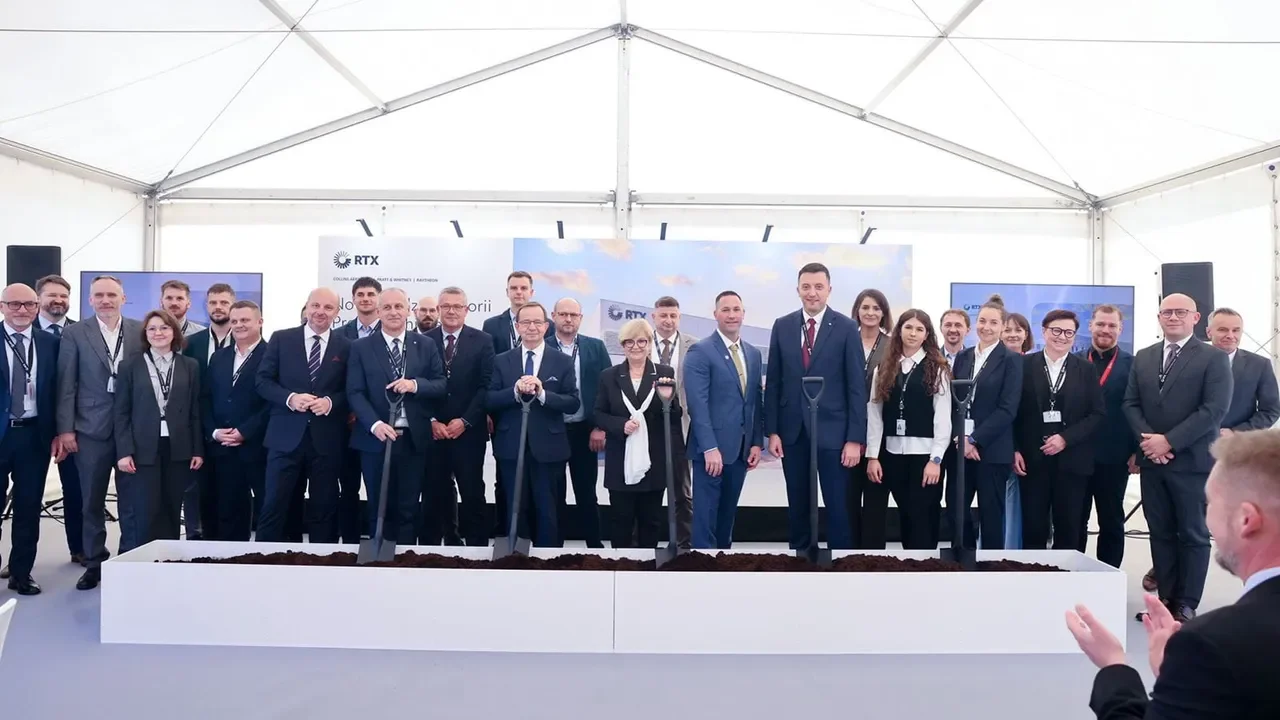
 A new Pratt & Whitney factory has broken ground in Poland, backed by a $100 million investment aimed at the compressor and turbine disk shortage that has left Airbus jets idling at completion centers for months. The timing matters because the GTF engine’s order backlog has passed 8,000 units, more demand than existing production can serve quickly enough.
Why the factory was needed
The Rzeszów groundbreaking didn’t happen in a vacuum. Airbus CEO Guillaume Faury said publicly that Pratt & Whitney has not met its engine delivery commitments and doesn’t appear on track to do so soon. Airbus attributed the shortfall to constrained delivery guidance and has started legal proceedings against the supplier.
The chokepoint is specific. Compressor and turbine disks, the high-precision rotating parts at the core of every engine stage, need isothermal forging under sustained extreme heat. That process is capital-intensive and has a long qualification lead time, so hiring more workers won’t solve it. The Rzeszów facility will house capabilities for processing isothermally forged parts, including heat treatment, sonic machining and inspection, to turn raw forgings into flight-certified hardware.
Six months from commitment to construction
Pratt & Whitney first disclosed the Rzeszów investment at the European Economic Congress in Katowice, presenting it as the European half of a production push on two continents. The groundbreaking moves that commitment into active construction six months after the announcement.
Piotr Owsicki, general manager of Pratt & Whitney in Rzeszów, spoke at the ceremony. It drew regional leaders including Rzeszów President Konrad Fijołek, Podkarpacie Regional Marshal Władysław Ortyl and Governor Teresa Kubas-Hul, a sign of firm regional government backing. Jason Kosmas, VP and GM of the Rotor Core Value Stream at Pratt & Whitney’s Columbus operation, also attended, which underlines how closely the Georgia and Poland expansions are tied. The two sites are designed to work together: Columbus Forge presses the isothermal forgings, and Rzeszów machines, heat-treats and inspects them.
What the Rzeszów site already does
The new building adds capability to a complex that is already one of Pratt & Whitney’s most technically diverse production sites outside the United States. Current output includes:
- The GTF fan drive gear system.
- F100 static structures.
- Key F135 parts for the F-35 Joint Strike Fighter.
- Engines for helicopters, business jets and general aviation aircraft.
A dedicated rotating-disk line gives the company flexibility to balance commercial and military demand from one location and reduces reliance on transatlantic component flows for the most highly stressed hardware in the GTF family.
The 30% figure airlines are watching
According to RTX, both the Rzeszów and Columbus expansions are expected to be fully operational by 2028, delivering a 30% uplift in critical rotating-component output at that point. In the meantime, RTX leadership pledged that Pratt & Whitney would deliver a record number of GTF engines, as aircraft-on-ground counts across the powered fleet began to decline. The Rzeszów plant is meant to sustain and speed up that recovery once it comes online. Airlines still waiting on new narrowbody deliveries, and Airbus, which is targeting a monthly production rate of 70 to 75 jets, have a direct interest in whether the 2028 timeline holds.
Poland’s aerospace profile
RTX’s footprint in Poland now spans three of its major businesses, Collins Aerospace, Raytheon and Pratt & Whitney, with a combined workforce that makes it the company’s largest employer base outside the United States. Rzeszów, a mid-sized city in southeastern Poland that has spent two decades growing into an aerospace hub, gains a level of capability few European locations can match. As engine supply chains reconfigure after the pandemic and Western defense industrial bases look to diversify geographically, its skilled labor, proven quality infrastructure and strong bilateral political alignment make it an increasingly important node, now backed by fresh capital and a clear deadline.

Comments
No approved comments yet.
Comments are reviewed by an administrator before they appear.