
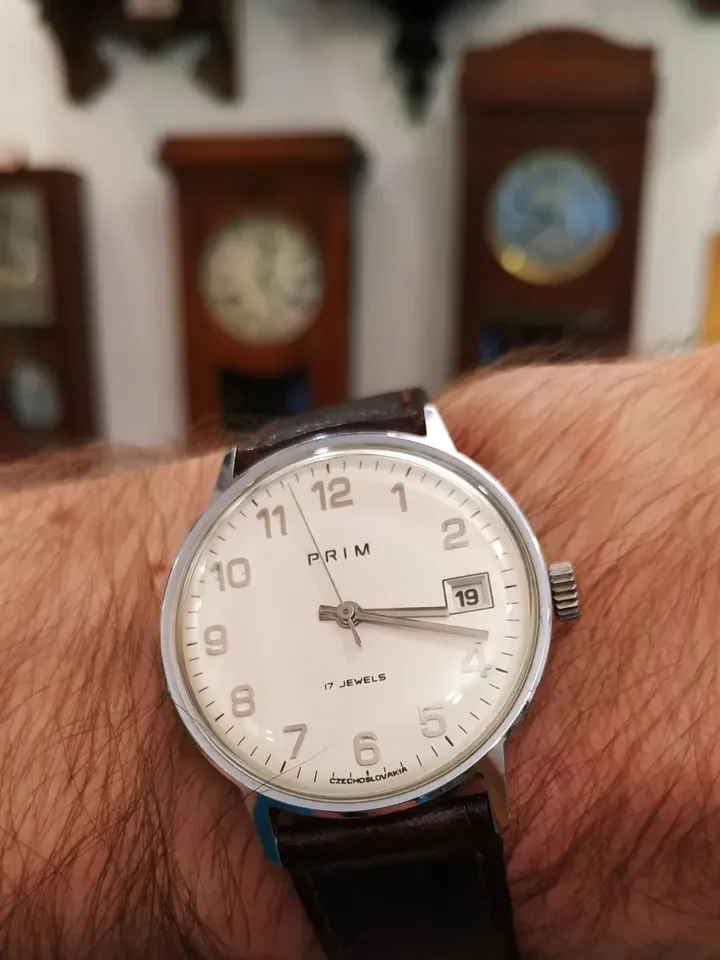
 The most telling object in a young collector’s rotation might be older than they are. Vintage watches, mechanical, built before the quartz crisis of the 1970s and delightfully impractical, have become one of the defining collecting crazes of the decade. Buyers in their twenties and thirties are driving prices, lively online forums and an entire restoration economy built around pieces their grandparents bought casually at airport duty-free shops or high street jewellers.
Why the appeal runs deep
The appeal is layered.
- A vintage watch is a sustainable choice in a way no newly made product can claim.
- It’s mechanically fascinating in an era of sealed, disposable electronics, visibly individual in a market saturated with identical smart devices, and, though nobody leads with it in polite conversation, a portable store of value that fits in a pocket and sparks real social connections.
How the secondary market matured
To see how the shift happened, look at how the secondary market matured. Over the past decade, better infrastructure transformed it. Reliable authentication services, greater auction transparency, comprehensive price databases and a new generation of watchmakers who livestream intricate restorations have turned a hobby once guarded by traditional dealers into an open, searchable marketplace. Online platforms document the new buyer’s education, and specialized collecting coverage tracks which references, the industry term for particular models, are appreciating and which are passing fads.
What veterans advise
Despite the excitement, veterans repeat a familiar liturgy of caution:
- Buy the seller first and the watch second.
- Always budget for regular servicing.
- Fear the overly polished case or the so-called frankenwatch assembled from mismatched parts.
A mechanical watch is a delicate machine that will need a specialist’s hands every few years. Devotees often see that ongoing maintenance relationship as part of the pleasure rather than a burdensome cost.
Craftspeople and the high street
Every big boom creates its own craftspeople. Independent watchmakers, historically scarce, aging and now booked out for months or even years, are the vintage market’s main limiting factor and its quiet aristocracy. Training programs and brand academies are expanding to meet demand, and restoration videos have become an unlikely mainstream streaming genre. Millions watch a seized 1960s movement come back to life under a master’s loupe, and those videos double as the hobby’s most effective recruitment films.
Slow time as a deliberate choice
Young collectors describe a consistent philosophy when pressed. They aren’t necessarily against new technology; they’re against a culture of disposability. A watch built to be serviced and repaired indefinitely by a real person, with precise parts and patience, answers a need in a generation raised on sealed units and subscriptions for everything. Slow time isn’t a naive retreat from the modern world but a sophisticated critique of it, worn proudly on the wrist.
The boom has produced one more unlikely beneficiary: the traditional high street jeweller. Collectors who arrived through online forums and auctions still need professional servicing, custom leather straps, official valuations and the occasional miracle on a water-damaged movement, and they overwhelmingly prefer dealing with a knowledgeable person to sending an anonymous parcel. Local shops that treat a twenty-six-year-old with a forty-year-old timepiece as a customer for life are quietly winning the retail decade. Slow time sells at traditional retail speed, provided somebody who knows their stuff is standing behind the counter.
There’s a deeper adjustment at work too. In a world where digital communication is instant and cloud storage makes physical media feel obsolete, tangible objects command a particular reverence. A vintage watch demands participation from its owner. It must be wound by hand or kept moving by the kinetic energy of a wrist, and if neglected, it simply stops. That requirement creates a relationship between wearer and machine that changes how people think about belongings. Rather than treating an accessory as a disposable consumer good, the modern enthusiast sees a mechanical watch as a generational baton, and themselves as temporary custodians of a piece of engineering that outlived its first buyer and will probably outlive them. That shifts consumption away from endless acquisition and toward preservation, stewardship and appreciation for craftsmanship.
In a frantic decade when every glowing screen begs for attention, a mechanical device that does nothing more than tell the time, slowly, mechanically and beautifully, has become a small wearable manifesto. The young collectors fueling this market aren’t just indulging nostalgia. They’re making a deliberate choice about how they interact with the material world.

Comments
No approved comments yet.
Comments are reviewed by an administrator before they appear.